 Michael A. West III
Spotify sells you back to yourself.
Every streaming service has the same songs. Spotify wins on psychology, not catalog. A teardown of how it turns human behavior into the most efficient growth engine in consumer tech, plus a campaign concept built on the same mechanics.
Same catalog, different product
Apple Music, YouTube Music, and Spotify license the same catalog, but one of them dominates the cultural conversation every December.
Spotify markets the listener rather than the catalog. Wrapped, Discover Weekly, Blend, and Daylist each take listening behavior and return it as identity. This teardown covers the four psychological levers that make that work, the growth loop they quietly power, and a campaign concept that extends the engine from one spike a year to four.
Four behavioral levers doing the marketing
None of the four are about sound quality.
A personality test you didn't know you took
People share what signals who they are. Wrapped reframes listening data as a statement of identity, so posting it reads as self-expression rather than promotion of an app.
“Your” year, “your” playlist
Ownership language makes the product feel like something to lose. Calling it your Discover Weekly raises the cost of leaving.
Every Monday, a new surprise
Discover Weekly refreshes on an unpredictable-payoff schedule, the same intermittent-reward pattern behind slot machines, applied to music discovery.
Built to be posted
Wrapped's format is engineered for the story feed: vertical, screenshot-ready, templated. Each share reaches a new audience through a friend rather than an ad.
Wrapped functions as an acquisition channel, not only a campaign.
The loop keeps the cost per new user low.
The data makes the artifact, the artifact gets shared, and the share brings in the next user. Paid acquisition sits outside that loop, so most of Wrapped's growth is earned.
The loop fires once a year. This concept runs it four times.
Wrapped raises engagement every December, then fades and casual users drift. This concept runs the same loop each season and gives lapsed users a reason to return.
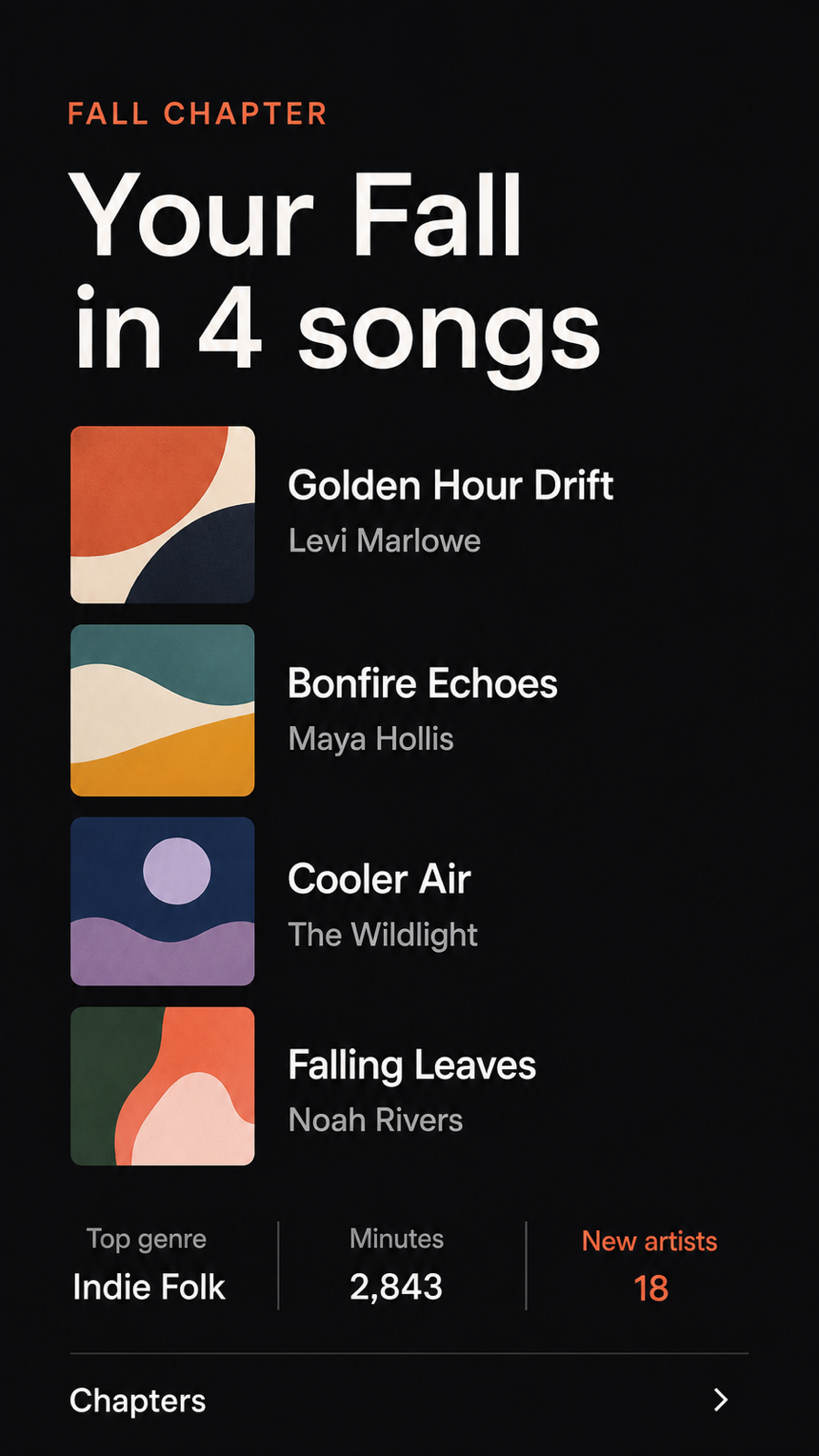
Chapters
A quarterly, shareable identity moment tied to life's seasons. Same psychology as Wrapped (identity, ownership, social currency) plus the fresh-start effect: people re-evaluate who they are at temporal landmarks. Chapters attaches an artifact to those moments.
Planned against KPIs, not vibes
Chapters would run against a holdout and be read on four numbers.
I'd A/B the card creative and the push copy against a holdout, watch DAU lift across the launch window, and kill or scale on signup-per-share, which is the number that shows whether the artifact works as an acquisition channel.
The starting question is which human behavior the campaign uses, then the creative and the metric are built around it.
Let's talk →